Sudoku looks like a math puzzle because it is full of numbers, but the numbers are just symbols. The sudoku rules are short enough to state in a single sentence, and once you understand the grid you understand the whole game. Here is exactly how a puzzle is built and what you have to do to solve it.
The grid
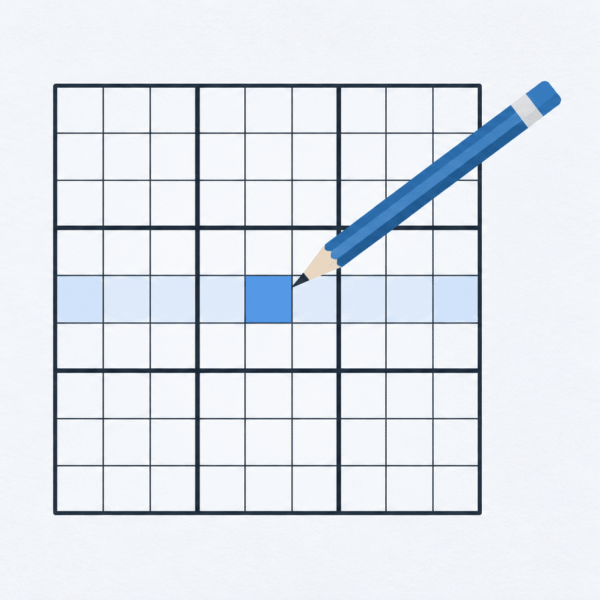
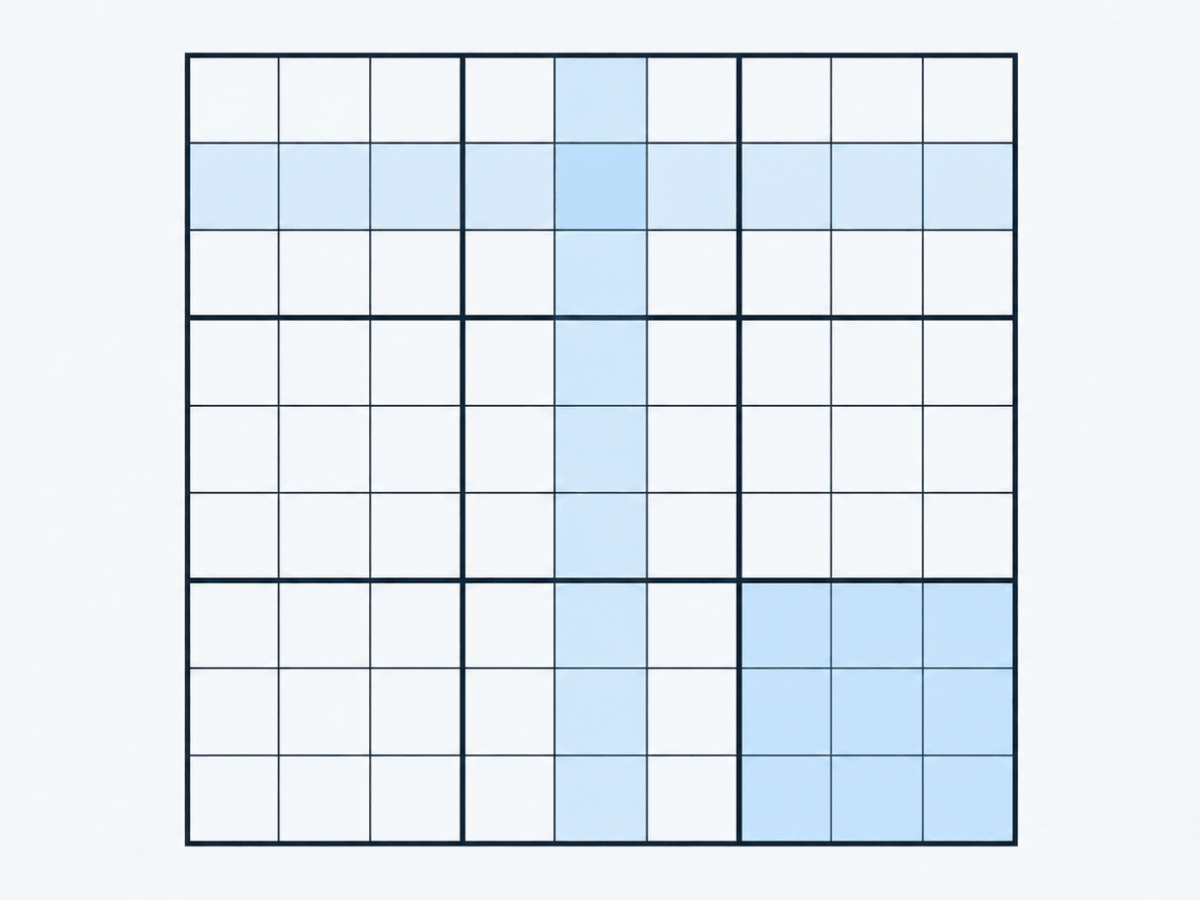
A standard sudoku is a square grid of 81 cells, arranged as 9 rows and 9 columns. That large square is also divided into nine smaller squares of 3×3 cells each. These smaller squares are usually called boxes (also blocks or regions). So every cell belongs to three groups at once: one row, one column, and one box.
Keeping those three groups in mind is the key to reading the board. When you place a number, you are affecting all three of the groups that the cell sits in.
The one rule
There is really only one rule in sudoku:
Each row, each column, and each 3×3 box must contain the digits 1 through 9, with no digit repeated.
That is the entire game. Every row uses 1 to 9 exactly once. Every column uses 1 to 9 exactly once. Every box uses 1 to 9 exactly once. If you ever place a digit that repeats within the same row, column, or box, the placement is wrong.
Notice what the rule does not say. It says nothing about adding numbers, and nothing about diagonals. In a standard puzzle the two long diagonals carry no constraint at all.
Givens: the starting numbers
A blank grid would have countless valid fillings, so every puzzle starts with some cells already filled in. These pre-filled numbers are called givens (or clues). You never change or remove a given; you treat it as fixed and work out the empty cells around it.
The givens are what make one specific solution possible. Your job is to use them, together with the one rule, to deduce what belongs in each empty cell.
Exactly one solution
A properly made sudoku has exactly one solution. This matters more than it first appears. Because the answer is unique, you never have to guess: every correct digit can be reached by logic from the clues you already have. If a puzzle allowed two or more different completed grids, it would not be a proper sudoku, and you would be forced to guess between them.
This single-solution property is why sudoku is a deduction puzzle rather than a game of chance. When you are stuck, the information you need is on the board; you have not found the reasoning yet.
No math required
Sudoku uses the digits 1 to 9 purely as a set of nine distinct symbols. You never add, subtract, multiply, or count them. You could replace the numbers with nine letters or nine colors and the puzzle would work in exactly the same way. What you are really doing is placing nine different symbols so that none repeats in any row, column, or box.
So arithmetic skill has nothing to do with solving speed. The puzzle rewards pattern recognition and logical elimination. For a step-by-step walkthrough of the techniques that turn these rules into a filled grid, see our guide on how to play sudoku.
What the word sudoku actually means
The name is Japanese and younger than the puzzle. The modern grid was designed by Howard Garns, a retired American architect, and first published by Dell Magazines in 1979 under the name Number Place. In 1984 Maki Kaji of the Japanese puzzle company Nikoli brought it to Japan as Suji wa dokushin ni kagiru — roughly “the digits must stay single” — and then shortened that mouthful to sudoku (数独), taking the first character of each key word: su, number, and doku, single. So the name is literally the rule: every digit alone in its row, column and box. The word is even claimed as a trademark in Japan, where competing publishers still say Number Place or “nanpure”; the rest of the world learned the puzzle as sudoku after it reached The Times of London in 2004 and spread through newspapers worldwide.
Where difficulty comes from
Since the rules never change, you might wonder why one puzzle is labeled easy and another expert. Difficulty comes from two related things:
- How many givens are provided, and where. Fewer starting clues generally leave more work to do, though placement matters as much as the raw count.
- Which solving techniques are required. An easy puzzle can be finished by spotting cells with only one possible digit. Harder puzzles hold back until you apply more advanced logic, such as narrowing candidates across a box and eliminating options that appear elsewhere.
A puzzle is not harder because it uses bigger numbers or more of them. It is harder because reaching the next correct digit takes a longer chain of reasoning.
The same rules scale up and down
The one-rule structure is not tied to the 9×9 board. A 6×6 sudoku uses the digits 1 to 6 across six rows, six columns, and six rectangular boxes. A 16×16 grid extends the idea further, often using digits and letters together. In every size the principle is identical: each row, column, and box contains each symbol exactly once. If you want to see how the core rule adapts to these formats and to added constraints, read sudoku variants explained.
Frequently asked questions
Can a number repeat anywhere in sudoku?
No. A digit may appear only once in each row, once in each column, and once in each 3×3 box. Across the whole grid a digit appears nine times in total, but never twice within the same row, column, or box.
Do the diagonals have to contain 1 to 9?
Not in standard sudoku. The rule applies only to rows, columns, and boxes. Some variants add a diagonal constraint, but in a normal puzzle the two main diagonals can hold any mix of digits.
Is guessing ever necessary to solve a sudoku?
In a properly made puzzle, no. Because there is exactly one solution, every digit can be found by logic from the givens. If you feel forced to guess, there is usually a deduction you have not spotted yet.
Do I need to be good at math to play?
No. Sudoku involves no arithmetic. The digits are just nine distinct symbols, and solving depends on logic and elimination, not on calculation.