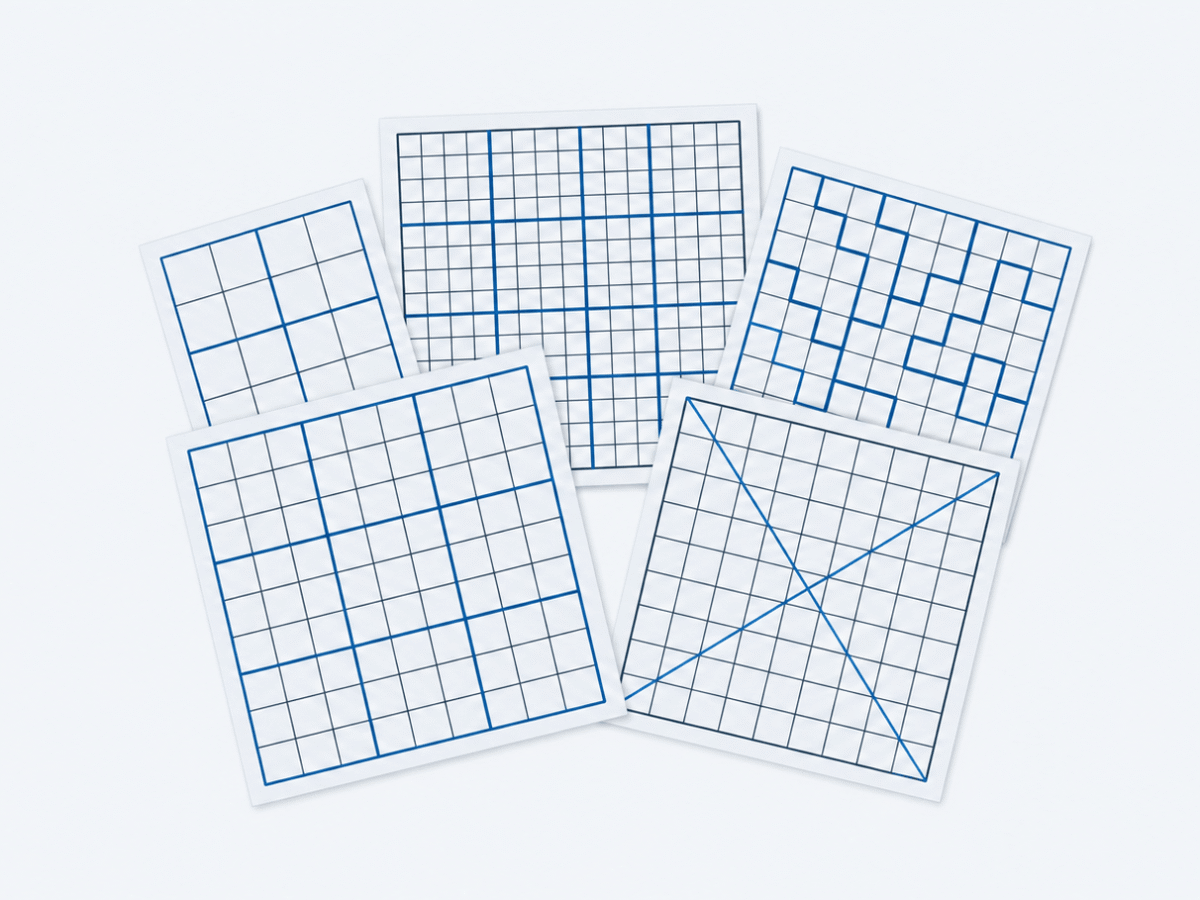
Every version of sudoku rests on the same idea. You fill a grid so that no symbol repeats inside a row, a column, or a marked region. The classic puzzle uses the numbers 1 to 9, but nothing in that rule depends on numbers or on a 9×9 board. Change the size of the grid, the shape of the regions, or the set of symbols, and you get a family of sudoku variants that look different yet solve by the same logic. This guide explains the most common ones and what actually changes in each.
If you are new to the puzzle, it helps to be comfortable with the basics first. Our guide on how to play sudoku covers the core rule in detail, and everything below builds on it.
The rule every variant shares
In a standard puzzle, the grid is divided into rows, columns, and boxes, and each of those groups must contain every symbol exactly once. That single constraint is the whole game. When you meet a new variant, the useful question is what the designer added or swapped. Usually it is one of three things: a different grid size, a different region shape, or a different symbol set. Some variants also add an extra region, such as a diagonal, that must hold the full set too.
Classic 9×9 sudoku
The baseline. A 9×9 grid split into nine 3×3 boxes, filled with the digits 1 through 9 so that each digit appears once per row, once per column, and once per box. Every other variant on this page is a modification of this template, which is why learning the classic version transfers to all of them.
Mini sudoku and kids sudoku
Mini sudoku shrinks the board, most often to a 6×6 grid divided into six 2×3 boxes and filled with the digits 1 to 6. A 4×4 version with 2×2 boxes and the digits 1 to 4 is common for children. The rules are identical to the classic puzzle; there is simply less to track, which makes these a good starting point for kids and beginners. The smaller symbol set means fewer possibilities per cell and faster solving.
16×16 sudoku (hexadoku)
This variant scales up instead of down. The grid is 16×16, divided into sixteen 4×4 boxes. Because you need sixteen distinct symbols, it borrows from hexadecimal and uses the digits 0 through 9 plus the letters A through F. Each character appears once per row, column, and box. The logic is unchanged; the larger grid just demands more patience.
Wordoku
Wordoku keeps the 9×9 structure but replaces the digits with nine letters. No letter may repeat within a row, column, or box, exactly as digits would not. Because the symbols are letters, some wordoku puzzles are built so that a chosen row, column, or diagonal spells a hidden word once solved. That word is a bonus feature, not a rule you solve by; the underlying constraint is unchanged.
Symbol and shape sudoku
Here the symbols are colors, shapes, or small pictures instead of digits. Nothing about the solving changes, because the puzzle never relied on the numeric value of the symbols. Each shape must appear once per row, column, and box. These versions make it clear that sudoku is pure logic, which is why they are popular with younger solvers.
Killer sudoku
Killer sudoku combines the classic grid with light addition. The board usually starts with no given digits. Instead, cells are grouped into outlined regions called cages, and each cage shows a target sum. The digits inside a cage must add up to that total and may not repeat within the cage, while all the standard row, column, and box rules still apply. The sums give you a second source of deductions, so a cage of two cells summing to 3 can only be 1 and 2.
Jigsaw sudoku (irregular sudoku)
Jigsaw sudoku, also called irregular sudoku, replaces the nine 3×3 boxes with nine irregular, interlocking shapes that fill the grid. Each region still contains the digits 1 to 9 once, along with the usual row and column rules. Because the regions bend around the grid, familiar box-based patterns do not apply, and you have to read each region’s outline carefully.
Diagonal sudoku (X-sudoku)
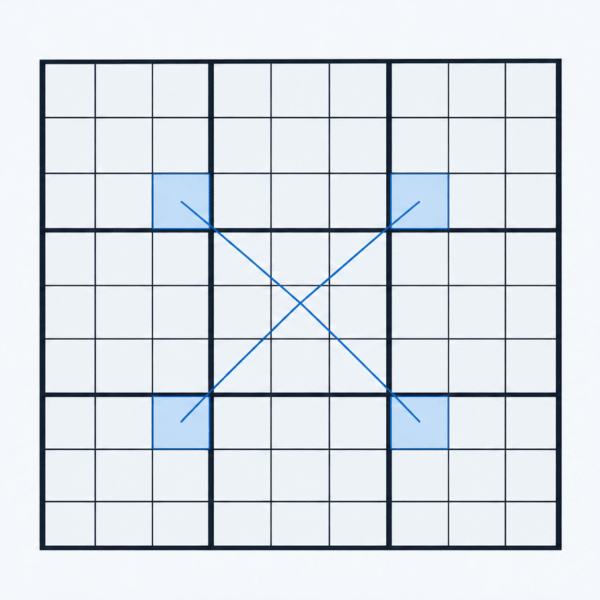
Diagonal sudoku, often called X-sudoku, adds one constraint to the classic puzzle. On top of the row, column, and box rules, each of the two main diagonals must also contain the digits 1 through 9 with no repeats. The two diagonals form an X across the grid, which gives the variant its name. That extra rule usually makes the puzzle tighter and opens up deductions the classic version would not allow.
Choosing where to start
Once you see the shared rule, the whole family opens up. Smaller grids ease you in, symbol versions make the logic plain, and killer, jigsaw, and diagonal puzzles add a single twist each. Browse our variant sudoku games to try each one and find the style that suits you.
The cage-and-sum variant now has a full walkthrough of its own: killer sudoku rules and the 45-rule technique.
Frequently asked questions
Do sudoku variants use the same solving techniques?
Mostly yes. Scanning, checking candidates, and elimination work across every variant because they all forbid repeats within a group. Variants that add a region, such as diagonal sudoku, or a sum, such as killer sudoku, simply give you extra constraints to apply alongside the usual ones.
Do killer sudoku cages need distinct digits?
Yes. Within a single cage no digit may repeat, and the digits must add up to the cage’s printed total. The normal rule that a digit cannot repeat in a row, column, or box still holds on top of that.
Does the hidden word in wordoku help you solve it?
No. The hidden word is a finishing touch, not a solving aid. You solve a wordoku by treating the nine letters as symbols that cannot repeat in any row, column, or box, exactly as you would treat digits.
Which variant is easiest for beginners?
A smaller grid is the gentlest start. A 4×4 or 6×6 mini sudoku uses the same rules as the full puzzle but with fewer symbols, so there is less to track. Shape and symbol sudoku are also approachable because they remove any impression of math.
Games mentioned in this article
- Microsoft Sudoku — filed under Sudoku
- Sudoku — filed under Sudoku
- Shapes Sudoku — filed under Variant Sudoku
- Classic Nonogram — filed under Logic Games
- Super Sudoku — filed under Sudoku
- Master Sudoku — filed under Sudoku