Sudoku is a logic puzzle played on a 9×9 grid. There is no math and no guessing involved — just one simple rule and a bit of careful reasoning. This guide explains the board, the single rule that governs every puzzle, and a reliable step-by-step method you can use to solve your first grid today.
What is sudoku?
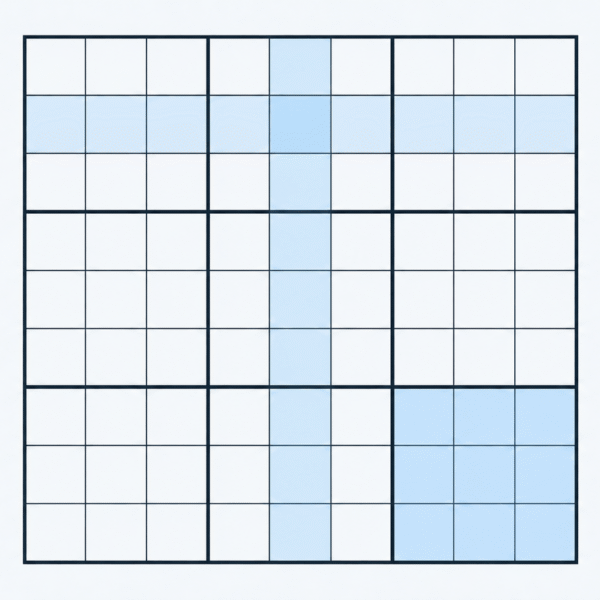
A standard sudoku board is a large square split into nine rows, nine columns, and nine smaller 3×3 boxes. At the start, some cells already hold numbers. These starting numbers are called the givens (or clues), and they are the same for everyone attempting that puzzle. Your job is to fill in every empty cell so the whole grid obeys one rule.
A well-made sudoku has exactly one solution, and you can always reach it by logic alone. If a puzzle forces you to guess, it was not built correctly. That single-solution promise is what makes sudoku fair: every step can be justified.
The one rule of sudoku
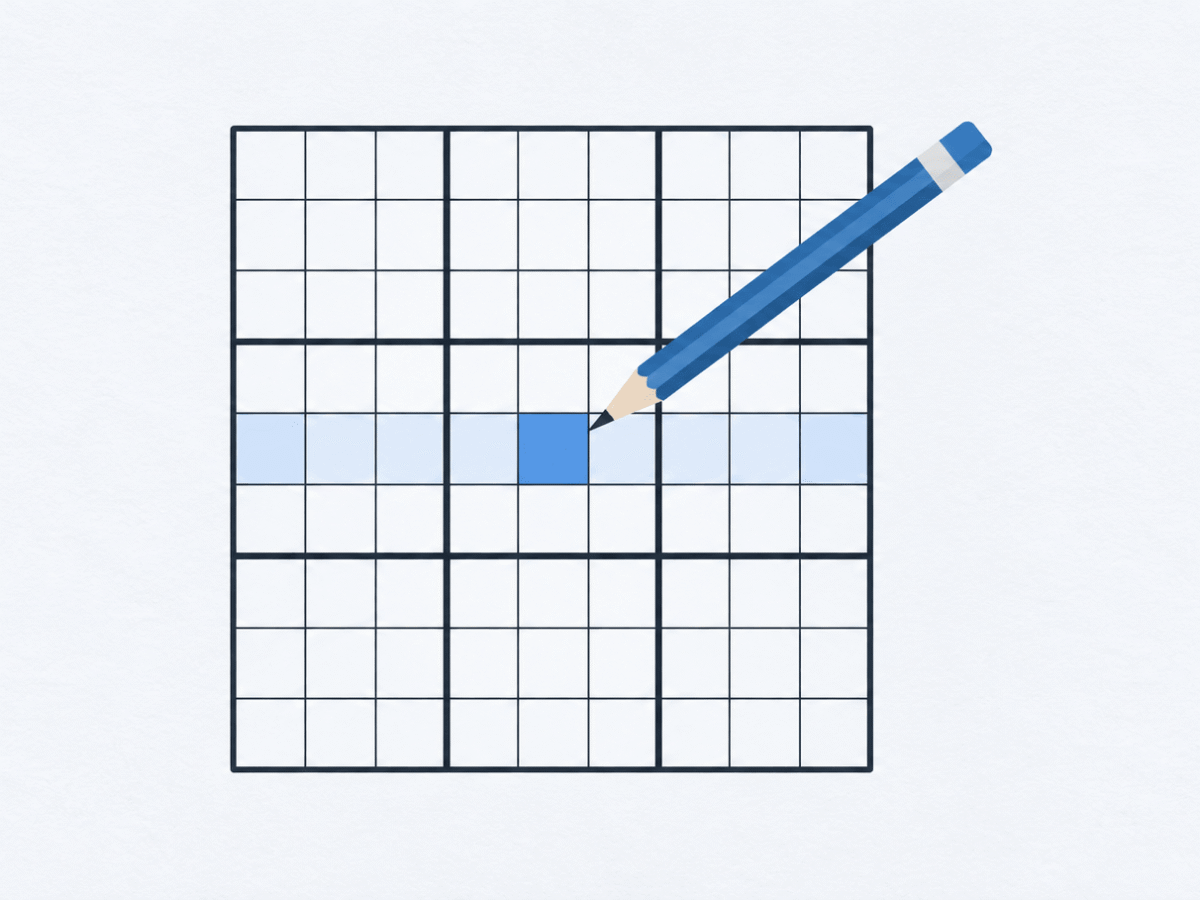
Every row, every column, and every 3×3 box must contain the digits 1 through 9, each exactly once. That is the entire rule. Three consequences follow from it, and they are the tools you will use to solve:
- A digit cannot repeat within the same row.
- A digit cannot repeat within the same column.
- A digit cannot repeat within the same 3×3 box.
Notice what the rule does not require: no addition, no multiplication, no ordering. The numbers 1–9 are just nine distinct symbols. You could play the same puzzle with nine colors or nine shapes and nothing would change. Sudoku is a puzzle of position and logic, not arithmetic.
How to play, step by step
Here is a beginner method that will carry you through most easy and medium puzzles without any advanced tricks.
- Scan for the easiest digit first. Pick a number that already appears several times on the board — say the 5s. Look at each 3×3 box that is still missing a 5 and ask: given the 5s already placed in nearby rows and columns, is there only one cell in this box where a 5 can legally go? If so, place it.
- Work box by box, then row by row. Repeat that scan for every digit. This technique, called cross-hatching, uses the rows and columns that already contain a digit to rule out cells in the boxes that don’t.
- Look for cells with only one option. When scanning stalls, switch focus to a single empty cell. Check its row, its column, and its box. If eight of the nine digits already appear among those three groups, the ninth digit is forced — it is the only value that fits. This is called a naked single.
- Look for digits with only one home. The mirror image: within one row, column, or box, a particular digit may have just one empty cell where it is still allowed. Even if that cell has other candidates, the digit must go there. This is a hidden single.
- Use pencil marks when it gets hard. For tougher grids, lightly note the possible digits (candidates) in each empty cell. As you place numbers, erase candidates that are no longer legal. The marks reveal patterns that are invisible otherwise.
- Never guess. If you feel the urge to guess, there is always a logical step you have missed. Slow down, re-scan, and the next move will appear. Every correct sudoku can be finished by reasoning.
A worked example in words
Suppose a 3×3 box in the top-left is missing a 7, and the two rows passing through its empty cells already contain a 7 elsewhere, while one of its columns also has a 7. Cross those lines off in your mind. If only a single cell in that box has no 7 in its row, column, or box, then that cell must be the 7. You have just made a move that is impossible to dispute — that certainty is the heart of the game.
Where difficulty comes from
Two things make one puzzle harder than another: how many givens you start with, and which techniques are required to progress. Easy grids fall to simple scanning and singles. Harder grids withhold those easy moves, so you need candidate marks and pair-based logic; the toughest (“expert” or “evil”) puzzles demand advanced patterns. The rule never changes — only the depth of reasoning does. For a structured tour of these methods, see our guide to sudoku solving techniques.
The same rules, many shapes
Once the core rule clicks, it transfers to every relative of classic sudoku: smaller 6×6 grids for kids, larger 16×16 boards, letter-based wordoku, shape sudoku, and constraint twists like killer or jigsaw. The board or the symbols change; the “each group holds a full set, once” idea stays. Our sudoku variants explained guide walks through the popular ones.
Tips to improve
- Finish easy puzzles cleanly before moving up — speed comes from recognizing patterns, not rushing.
- Always place a digit for a reason you could explain out loud.
- When stuck, change your focus: from a digit (where can this number go?) to a cell (what can go here?).
- Keep pencil marks tidy; a messy grid hides the next move.
That is everything you need to start. Pick an easy grid, scan for a common digit, and place your first certain number.
When the rules feel comfortable and you want a repeatable placing order, the step-by-step solving method turns them into a routine.
Frequently asked questions
Do you need to be good at math to play sudoku?
No. Sudoku uses the digits 1–9 only as distinct symbols, and no arithmetic is ever required. It is a pure logic puzzle; you could swap the numbers for shapes or letters and it would play identically.
Does every sudoku have only one solution?
A properly constructed puzzle has exactly one solution that can be reached by logic alone. If a grid has multiple solutions or forces guessing, it was built incorrectly.
Should I ever guess in sudoku?
No. Any correct puzzle can be finished by reasoning. If you want to guess, it means a logical move is available that you haven’t spotted yet — re-scan the rows, columns, and boxes.
What is the difference between a naked single and a hidden single?
A naked single is an empty cell where eight digits are already blocked, so only one value fits that cell. A hidden single is a digit that has only one legal cell left within a row, column, or box, even if that cell still has other candidates.
Games mentioned in this article
- Microsoft Sudoku — filed under Sudoku
- Sudoku — filed under Sudoku
- Shapes Sudoku — filed under Variant Sudoku
- Classic Nonogram — filed under Logic Games
- Super Sudoku — filed under Sudoku
- Master Sudoku — filed under Sudoku