Every standard sudoku has exactly one solution that can be reached by logic alone. You never need to guess. The skill is knowing which deduction to apply and when. This guide walks through the core sudoku techniques in order of difficulty, so you can build a reliable solving routine and recognize when a harder pattern is called for.
Throughout, remember the single rule that drives every method: each digit from 1 to 9 must appear exactly once in every row, every column, and every 3×3 box. A “unit” means one of those groups. New to the board itself? Start with our guide to how to play sudoku, then come back here for strategy.
Techniques, from easy to advanced
1. Scanning and cross-hatching
Scanning is the first thing to do on any grid. Pick a digit, see where it already appears, and use those rows and columns to rule it out elsewhere. Cross-hatching focuses this on a single box: if a 5 sits in two rows crossing a box, and a column covers a third cell, the 5 can only go in the box’s remaining open cell. You place a digit whenever a box, row, or column has one spot left for it. This alone solves easy puzzles and opens up harder ones.
2. Naked singles
A naked single is a cell that has only one possible digit left. Look at an empty cell and eliminate every digit already present in its row, its column, and its box. If that leaves exactly one candidate, that digit is the answer for the cell. Naked singles are the most direct deduction in sudoku: the cell itself tells you what it must be, with no other cell needed to confirm it.
3. Hidden singles
A hidden single works from the unit rather than the cell. Take a digit and a single unit, say a row. If that digit can legally go in only one cell of the row, it belongs there, even if that cell still lists several other candidates. The digit is “hidden” among those other candidates, but since it has nowhere else to sit in the unit, it is forced. Hidden singles are one of the most common ways to make progress and are worth checking for every digit in every row, column, and box. For a deeper look at these two, see our guide to naked and hidden singles.
4. Candidate and pencil-mark bookkeeping
Once easy placements dry up, write pencil marks: the small list of still-possible digits in each empty cell. Bookkeeping does not place a digit by itself, but it is the foundation for every method below. When you place a digit, immediately remove it from the pencil marks of every cell sharing its row, column, or box. Accurate, current candidates are what let patterns like pairs and locked candidates become visible.
5. Naked pairs and triples
A naked pair appears when two cells in the same unit have exactly the same two candidates and nothing else, for example both cells holding only {4, 7}. Between them, those two cells must use up the 4 and the 7, so no other cell in that unit can be 4 or 7. You erase 4 and 7 from every other cell of the unit. A naked triple is the same idea with three cells that together contain only three candidates (each cell can hold two or three of them); those three digits are locked into those three cells and can be removed from the rest of the unit.
6. Hidden pairs
A hidden pair is the mirror image of a naked pair. If two digits can each go in only the same two cells within a unit, then those two cells must hold those two digits between them. That means you can erase every other candidate from those two cells, even though the cells may have listed extra options before you spotted the pattern. Hidden pairs are easy to miss because the key digits are buried among other candidates, so scan each unit for any digit that has only two possible homes.
7. Pointing pairs and box-line reduction (locked candidates)
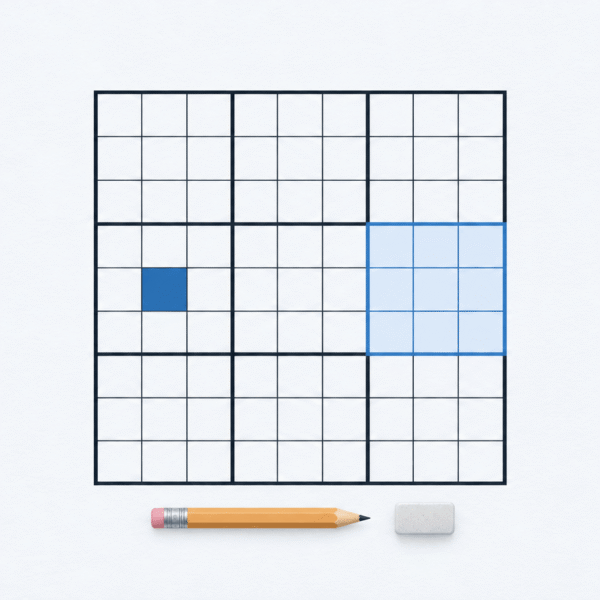
Locked candidates connect a box to a row or column. A pointing pair (or triple) happens when, inside one box, all remaining spots for a digit fall on a single row or column. Because that digit must go somewhere in the box, and every option lies on that line, the digit can be removed from the rest of that row or column outside the box. Box-line reduction is the reverse: if a digit within a row or column is confined to the cells that also sit in one box, you can eliminate that digit from the other cells of that box. Both rely on the same fact, that a digit shared by a box and a line must satisfy both units at once.
8. Advanced patterns: an intro to X-Wing
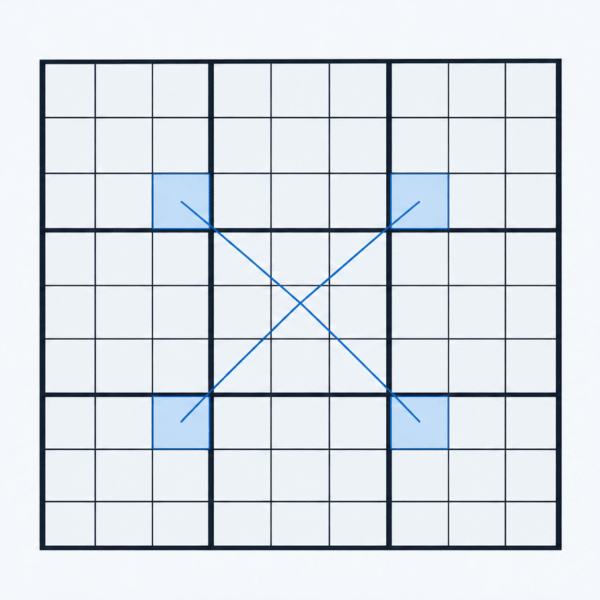
When singles, pairs, and locked candidates stall, deeper patterns take over. The X-Wing is a good first one to learn. Find a digit that, in two different rows, is limited to the same two columns, two candidate cells per row. Those four cells form a rectangle. Because each of the two rows must place the digit in one of those two columns, the two columns are fully accounted for by these rows, so the digit can be eliminated from every other cell in both columns. The same works with the roles of rows and columns swapped. X-Wing is your gateway to related fish patterns and to techniques like the Swordfish. For the full pattern, see our X-Wing guide.
Solve with logic, never guessing
A well-formed sudoku never requires a guess. Every technique here is a deduction: it proves a digit belongs somewhere or proves it cannot. If you want to pick a candidate at random, it almost always means a hidden single, a locked candidate, or a pair is sitting unnoticed. Recheck the units around your last few placements before assuming you are stuck.
How to practice
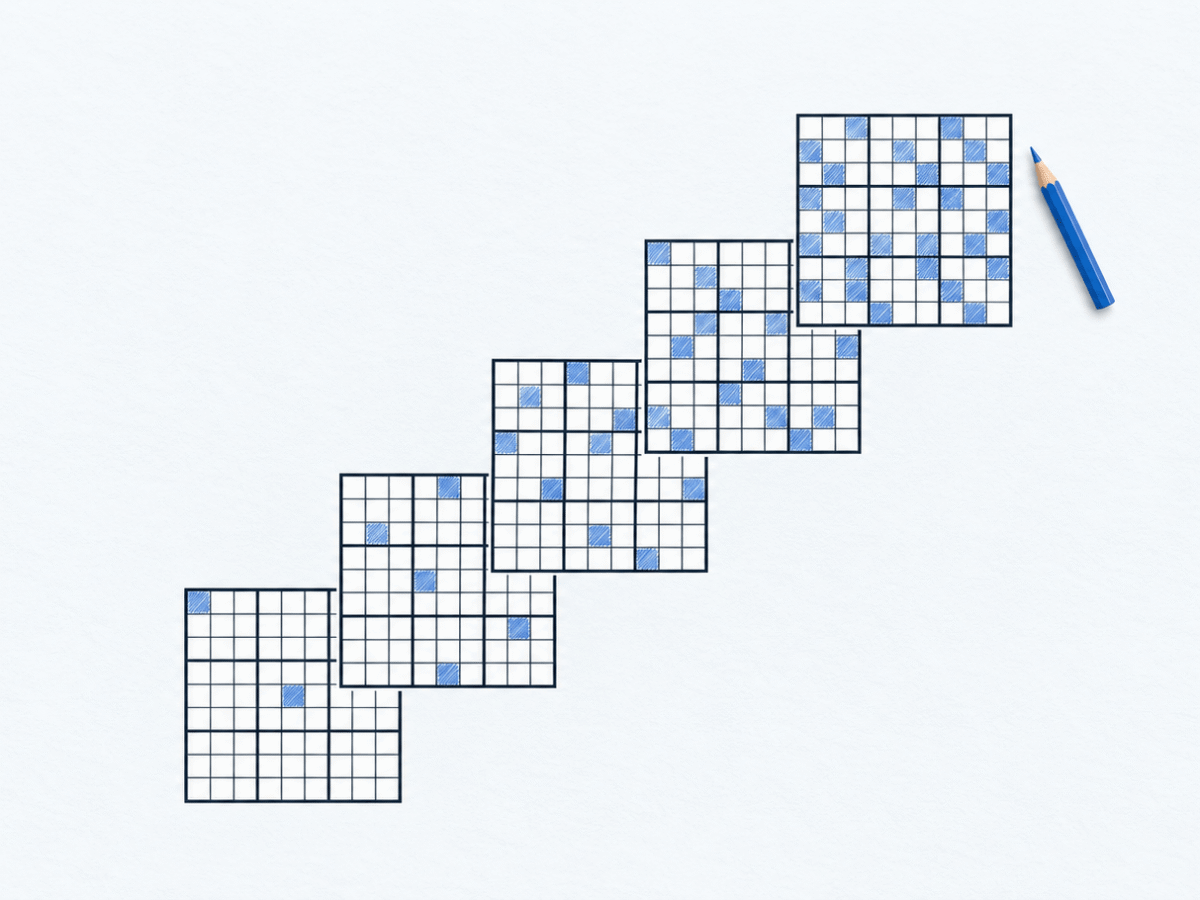
Build the habit in order. On each new puzzle, scan for singles first, then write full pencil marks, then hunt for naked and hidden pairs, then locked candidates, and only reach for X-Wing when nothing simpler works. Solving the same puzzle twice, once for speed and once to name every technique you used, teaches your eye to spot patterns faster than solving many puzzles carelessly. Over time the easy methods become automatic, and the harder ones stop looking like magic.
If you want these deductions arranged into one repeatable order of operations, the step-by-step solving walkthrough does exactly that.
Playing the cage variant? The killer sudoku guide shows how its sums seed the board before these deductions take over.
Frequently asked questions
What is the difference between a naked single and a hidden single?
A naked single is found by looking at one cell: after eliminating digits used in its row, column, and box, only one candidate remains. A hidden single is found by looking at one unit: a digit that can legally go in only one cell of that row, column, or box, even if that cell still lists other candidates.
Do I ever need to guess in sudoku?
No. A properly constructed sudoku has a single solution reachable by logic alone. If you feel forced to guess, a deduction has been missed, usually a hidden single or a locked-candidate elimination. Rechecking your pencil marks almost always reveals the next logical step.
In what order should I apply these techniques?
Start simple and escalate only when needed: scanning and singles first, then careful pencil marks, then naked and hidden pairs, then pointing pairs and box-line reduction, and finally advanced patterns like X-Wing. Most puzzles fall to the earlier methods, so you rarely reach the hard ones.
Are pencil marks a technique or just note-taking?
They are note-taking that makes techniques possible. Pencil marks do not place a digit on their own, but naked pairs, hidden pairs, locked candidates, and X-Wing all depend on an accurate candidate list. Keeping those marks current after every placement is what lets the patterns become visible.
Games mentioned in this article
- Microsoft Sudoku — filed under Sudoku
- Sudoku — filed under Sudoku
- Shapes Sudoku — filed under Variant Sudoku
- Classic Nonogram — filed under Logic Games
- Super Sudoku — filed under Sudoku
- Master Sudoku — filed under Sudoku